vrijdag 3 januari 2020

Hagenaar (zand) of Hagenees (veen)

Langs de kust liggen hoge stroken zand. Aan zee heten die de duinen, en landinwaarts zandruggen. De stroken in de dalen tussen de zandruggen vulden zich met veen.

Wie in Den Haag geboren is op het zand, wordt wel Hagenaar genoemd. Wie geboren is op het veen, is een Hagenees.
Allemaal onzin natuurlijk, want je kunt Hagenaars en Hagenezen ook op andere manieren onderscheiden. Woont er niet meer vs. wil er nooit weg. Zegt 'veur' of zegt 'voâh'.

Al in een eerdere post (hier, uit 2007) concludeerde ik dat ik, binnen de gemeente Den Haag, eigenlijk een Scheveninger ben, vlak achter de haven geboren. Daar komt nu bij dat ik Hagenees ben, want mijn geboortehuis - Frankenslag 142 - stond net op een veenstrook. Heeel dicht bij het zand, hoor. ('Hoâh. Heur?')

In het blauwe cirkeltje:


woensdag 29 mei 2019

Meeting Pete Myers

Pete Myers - without his trademark sunglasses
(Photo: Radio Netherlands)
Radio personality Pete Myers passed away on 15 December 1998. 

I briefly worked with him. Here are a few of my reminiscences.

Signing on

When Radio Netherlands hired me as a news and continuity presenter in 1996, I was shown around the building by Jonathan Groubert. Between his duties as a programme host he had apparently been assigned the task of welcoming new recruits - or maybe he just happened to be around after my confirmatory second interview with Personnel.

Jonathan walked me through the long corridors of the 1960s concrete office building, nipping into a little cubicle here and there, and showing me who lived there. "This is a place that you will come back to again and again: the secretary's office. This is Iris." The secretary looked up from her PC monitor, smiled and said, "So, you made it? Congratulations!" She had shown me in on my first interview, so we had already had some sort of introduction.

"Oh, and have you had your goodie bag yet? Every new staff member gets one," Iris said. Jonathan fished a white linen bag with the station logo out of a cupboard and peered into it. "Here you are, but there's something missing." He rummaged around in the same cupboard and came up with a little brown card box, lifting out what was inside and handing it to me. "This is the Radio Netherlands mug. Your voice will sound different when you drink from it!" I half believed him. Briefly.

The text on the shiny grey stoneware mug read "Radio Netherlands, all shades of opinion". I still have the mug, unchipped to this day, although the text has worn away completely. I drink from it regularly.

Pete's office

Next stop down the corridor was another long narrow cubicle, the door wide open. "Do go in," Jonathan said, following me.

At a desk by the open window, his back turned to us, a tall man sat hunched over a typewriter. "Pete, can I disturb you for a moment?"
"Sure Jonathan, anytime," Pete replied, turning towards us and straightening his back. Slightly balding, his hair still dark, Myers' handsome face examined me.
"Pete, this is Rob Kievit, our new continuity man and newsreader. Rob, this is Pete Myers."
Pete grabbed my hand and effusively said, "Very pleased to meet you, Rob, and welcome to this wonderful department. I'm so glad you're here - you must be the person who is finally going to relieve me of those dreadful night shifts," he said in that warm silver voice of his that I had only heard on short wave up to now.

"What," Jonathan said, "you, the Grand Old Man of Radio Netherlands, have been doing night shifts?" It turned out that there had been a gap in the roster - the only thing that could keep Iris awake at night. Pete happened to pass by the secretary's office and valiantly offered to fill in for a couple of weeks, "so you will finally get some sleep, dearest Iris".
Which is how Radio Netherlands' star presenter was suddenly scheduled for the least popular job on the roster: playing taped shows throughout the night, making brief announcements in between, and reading the news bulletins on the half hour. The graveyard shift.

"So, my friend, the powers that be found you suitable for the job? I have no doubt that you are. Do you have any qualities that might hinder you?"
"Well, I might be a bit too modest," I ventured, impressed by Pete's effervescent style.
"Nonsense my dear chap, modesty goes out the window here. We're all consummate professionals, and you will be one too. Whatever you do, preparation is everything. Look at me: after all those years, I'm still typing out every word I'm going to say on air. A man of habit. As you can see, I'm still using one of those contraptions" - pointing to the IBM golfball typewriter humming on his desk. "If you'll excuse me now, I've still got some work to do for the daytime job. I'll see you after my last night shift next week." With that he turned back to his typewriter.

Pete's past

It was only later that I learnt about Pete's long history in radioland - and elsewhere.

What I remember being told is that Pete Myers was among the first deejay crew that tried in the late 1960s to turn BBC's new pop station Radio One into a success. He had earlier brought enormous popularity to the African programme of the World Service. Pete, however, refused to become a standard diskjockey, all jokes and shouts, and soon decided he did not fit in with the station.

After leaving Radio One, Pete was not involved with broadcasting for a while and managed a nightclub in Beirut, Lebanon, then often described as the Paris of the Middle East.

He joined Radio Netherlands' English service and enthusiastically restyled their broadcasts to the African continent. Pete developed the hugely successful Afroscene show. When I began at RN, he was the host of the weekly listeners' letters show, Sincerely Yours. At one point Pete had trouble walking, and could not get to the studio. But rather than telephoning somebody to stand in for him, he organized an engineer and an editor to drive over to his home with some equipment and record the show right there in his bedroom.

But I did not know any of that history back in 1996. At the time I merely got to know Pete Myers as a courteous and professional colleague.

Morning shift

After a week of shadowing experienced announcers, learning the ins and outs of live continuity presentation from Dave Durham and Carol Vandenring, and receiving a thorough voice training from Robert Green, I was finally ready for the first morning shift on my own.

I arrived that Monday morning at a quarter to six, still sleepy-eyed but well in time for launching the 6:30 broadcast. Greeting the overnight engineer in passing, I entered the little studio, Cell 4, from where all the station's shows were broadcast. My predecessor on the roster, Pete Myers on his last night shift, had already gone home.

Pulling up the wheeled office chair - the hotseat - and pulling the microphone a little bit closer, I prepared for the show, cueing up the first two tapes I had to play. Then I nipped over to the newsroom, still empty at this early hour, but for a couple of nighttime editors dotted widely apart in the cavernous space. The English translator, who was nodding off at his desk, awoke with a shudder and handed me the nine A4 sheets which constituted the news bulletin.

Back in the studio, I sat down, put on my headphones and got ready for a pre-broadcast run-through of the bulletin, as I had been taught. My eye fell on a crumpled ball of paper, carelessly tossed away into a corner of the wide presenter desk with the mixing console. I smoothed out the A4-sized page. Somebody had written across the spreadsheet printout: "Done!"

The top line read: Roster; night shifts: Pete Myers.


vrijdag 17 mei 2019

Valedictory quadrangle

The Dutch Vignettes were written for an international audience. Some geographical names have been anglicized. See Footnotes for the originals.  

They look like lakes, but actually they are peat bogs. The wide lakes between Amsterdam and Utrecht are man-made, created by peat-cutters. The water-table in this part of the country being quite high, the ditches filled with water as soon as the peat was out, conveniently creating canals along which the dried soil could be removed. After years of peat extraction, the result was a plethora of useless lakes like those at Loosedrift.

House at Loosedrift
(Google Maps)
Heading west on my customary biking round, I follow a narrow road through a quite rural-looking village. To my right, in a park-like setting, I'm allowed a glimpse of the stately House at Loosedrift, painstakingly restored Dutch classicism at its best (so I thought - but actually it's a contemporary replica in 18th-century style, known locally as The Nine Limetrees). Well-hidden from the immodest public view by strategically grown shrubs and trees. No more than a glance to my right.

For years, this had been my bike training ride. A more or less square trajectory which I could complete in about an hour. The predictability made it easy to fit it into my day's schedule - not that I biked every day, but knowing how long it took certainly made it easier to decide to mount the purple Batavus Challenger and go. We were, however, about to leave Hilversum for another part of the country, so this ride would be my farewell to the square-shaped route. A valedictory quadrangle.

I am overtaken by a confidently spluttering green old-timer; caring for vintage cars is a popular pastime here of the well-to-do citizens that have taken up residence by the lakeside.

Further along the road, converted farmsteads, a village school, a few shops and a church. Decked out in orange vanes, fluttering in the breeze, a shop on the left of the road proclaims itself to be 'The New Baker', supplying 'bread and luxurious bonbons'. A determined-looking woman comes out holding a bag which she carefully stuffs into one of the panniers of her black bicycle and then she wheels off.

Next to the baker's is a modest church building. Not exactly a tin chapel, but in the same unassuming league. For such a small, relatively rural community, Loosedrift is remarkably well-endowed with churches. According to a varnished wooden plaque on its door, this one is serving the Reformed Parish, with a single service at 10am on Sundays. There's no-one around, today being Thursday.

The narrow two-lane road curves gently to the right, passing a shipyard full of pleasure boats, some cradled in wooden docks along the road: The Hare, Star Heres, Morning Star. Not everybody here appears to be into driving vintage cars. After all, the lakes are the attraction, not the roads.

Another, somewhat taller, church moves into view; this one, looking like a proper church with a tower, belongs to the Dutch Reformed parish, which is presumably not only larger than the other one, but also seems to be hungrier for the word of the Lord, being open for services Sundays at 10am and 6pm, so the plaque on the porch is saying.

The trees surrounding the church and lining the road turn this into a pleasant, shadowy spot. A fairytale touch is added by the castle to the right. As we're in the middle of a former peat bog this is unlikely to be a medieval fortification, and indeed it isn't. Seepstone Castle, a romantic folly that appears to have got out of hand, was built in the 1920s by the last remaining member of a noble family who wanted a lasting memorial to his ancestors.

A proper castle he wanted, with stables and varied gardens and all. The current head gardener is a somewhat gruff lady who appears to be in total control of the grounds. The result is most convincing, seen from the outside. I must admit that I swished past this place on my tenspeed numerous times, but never visited it.

Like many such places in the Netherlands, this hamlet too does not appear to feel embarassed by presenting such a predictable picture postcard village image. Even the horses pretending to do nothing, grazing on the grass meadows seem to be part of the conspiracy. Look, we're just an ordinary village.

But the picture changes when the narrow road widens into a deserted bus turning loop. This is where the ordered world ends, at this overgrown bus terminus with its sagging bus stop sign, while the road continues.

Gone are the baker and the horses; all of a sudden we're on a narrow tree-lined strip of land with a huge lake on both sides. The dam is the only land left after the peat was cut and carried off. The shipyard marking this point is called Treehook; once barren, the dyke is leafy. Dotted alongside the road are dwellings, many of which are unmistakeably weekend cottages standing empty, waiting for Friday evening to arrive.

Others are luxury villas, each with their own little jetty at the bottom of a lakeside garden. At least, that's what I assume, because many mansions are surrounded by tall walls or impenetrable hedges. Anything for privacy.


II

I grip my handlebars for a sharp turn to the left, and I'm heading south. On this side of my quadrangle, guess what, another shipyard, with huge yachts this time.  The road is not a dyke anymore; on the right is the bank of Southern Loosedrift Lake, while on my left long and narrow plots of land behind large bungalows reach out a bit further to the lake beyond, which is named after this settlement, Brooklyn Fawn.

My southbound pedalling is briefly interrupted by a left-right zigzag, during which I'm tracing the Utrecht-North Holland provincial border for a while.

The next church - it's not only shipyards and villas - is at Tenfarms. I don't bother to pull the brakes and inspect the service timetable next to the wooden door. The symmetrical building features a tower with a clock which is showing the correct time. But I must not look, because a sharp turn to the left over a simple bridge has to be negotiated carefully; on an earlier occasion I had to make an emergency stop here to avoid swerving into the water-filled ditch along the first part of the road east.

On early summer mornings, this leg of my square-shaped cycling round presents the epitome of Dutch clichés: a reddish sunrise acting as a backdrop to a windmill. Being an essential element in the local drainage system, the mill helps to keep the surrounding land dry, pumping water up into a clever network of ditches.

In recognition of its services through the years, and possibly as a charm to ward off mishaps, an earlier owner named the mill The Faithful Watcher. It looks like a wooden shed perched on top of a little thatched pyramid, but with its four sails it is unmistakably a windmill.

Averting my gaze from the picture postcard scene, the horizon to my left is dotted with a couple of tiny church spires and the Hilversum telecom tower. A sticker slapped on a traffic sign, no parking here, is advertising Radio 509, probably a very local station and one that definitely won't be using the telecom tower for its broadcasts.

I'm now on a long straight towards the east, below wide Dutch skies. Running right across the peaty area the road is aptly named Cross Dyke.

If this were Ireland...
(Google Maps)
Glancing to the right, trying to find the little stub that is Utrecht cathedral tower on the horizon, I'm looking across a former peat extraction zone which has been allowed to return to nature. A patchy mixture of water, soil, ducks, sheep - the landscape about which K. Schippers wrote: if this were Ireland, I would take a better look.

The road through 'Ireland' ends after an unmetalled strech of track which is not really suited for my light tenspeed bike with its high-pressure narrow tyres. Course gravel and pointy rocks are making an assault on them. But as it was the only way to complete my circuit, I always had to negotiate it. It is here, exactly half-way, that I suffered my one and only puncture in the decade or so that I regularly rode this circular, square, route. Serves me right, stingy Dutchman, for not renewing the worn-out tyres in time. So there I stood, a suddenly disabled rider. The weather being nice, I foolishly decided to retrace the circuit on foot, which would have taken two hours or so. Having reached the road again, I was passed by a young woman in a four-wheel drive. She stopped, took a worried look at me and said, 'Do you have to walk far?' - 'Hilversum,' I said. 'OK, I'll drop off my son at his judo classes and then I'll come back and drive you there, if you're still around,' she decided, leaving me little choice.

She drove off with her son and I plodded on, accompanied by floppy noises made by my flattened rear tyre. Some twenty minutes later I was again overtaken by a familiar-looking car. 'Hop on,' the businesslike young lady said. 'Your bike can go in the back.'

As we negotiated the narrow road, she told me that she had carried out such rescue operations before. 'You remind me of my father. He got stuck in the wilderness with a broken bike, and I had to go and fetch him.' She dropped me and the bike off on the corner of our street, barely waiting to hear my expressions of gratitude. And off she drove, back to the polder.

But this time around, my (new) tyres survive the cruelties inflicted on them by the rocky gravel path, and I continue east. Cross Dyke changes name at Eagleshook, a well-kept farming settlement, and becomes Count Floris V Road, named after a 13th-century ruler over Holland.

Here I lose the wide views. Both sides of the road are lined with trees and shrubs. A sandy path with lush green borders branches off at right angles to the left, into the green overgrowth, but with the memory of the rough gravelly stretch just behind me, I won't venture there.

I continue riding at a steady pace on the narrow lane, emulating Count Floris's determination. A car creeps up and remains politely behind me, possibly assuming that I'm a serious amateur cyclist systematically training for a major race. To live up to his expectations, I make an impatient wave forward with my left arm, signalling to the driver that it's safe to overtake me, so get on with it and stop pottering on behind me.  He carefully passes me on the left, blades of grass tickling my right calf. The driver raises one hand in recognition of my gesture.

Pedalling towards the end of Count Floris V Road, I see a couple of horse breeding farms and villas appear.  I'm approaching the last leg of my tour.


III

At the crossroads I change direction. Turning left again, to the north. This used to be the main connection between Utrecht and Hilversum: a two-lane road running in a straight line through some villages, until a parallel motorway was built, a couple of hundred metres to the east. I can hear it humming, invisible beyond the homes of Hollands Raiding village.

So, aiming for the north at the crossroads, I embark on the last leg of this ride which I've completed countless times over the years that we've lived in Hilversum. For the next two kilometres or so, we're on a separate cycling track beside the provincial road. For now, I'm using the paved cycling track on the left side. Occasionally, cars pass by, in both directions.

The first stretch is flat, and soon I pass underneath a huge viaduct that is being constructed here, crossing the road, bike lanes, and all. The concrete monstrosity is wide enough to carry six lanes, I notice when I'm passing underneath it. The cycle path has its own tunnel.

There is no six-lane motorway overhead, however. The viaduct will be a so-called ecoduct, and its surface will be covered in shrubs and other vegetation, forming a corridor between two adjacent nature reservation areas.

The Netherlands' "nature" is a patchwork of small protected areas of outstanding beauty, crisscrossed - or hacked to pieces - by roads, like the one that I'm riding along. Roads are an insurmountable, deadly barrier to animals who are innocently wandering from one protected zone to another. But once they will be able to cross over to the other side using the six-lane wide viaduct, hares, foxes, mice, badgers, toads and what have you, will have safe passage here. If they follow the centre line, shy animals like deer won't even see the road below.

No time for more thoughts about nature, because I'm approaching an odd-shaped little roundabout which I have to negotiate in order to continue straight ahead, but on the other side of the road.

This is where the hilly bit finally begins, conveniently positioned towards the end of my hitherto flat ride. I have often rounded the loop in the opposite direction; less pleasant because then I had to start climbing right away, before my leg muscles had had a chance to warm up.

Now though, I swiftly make the first ascent, up Swallow Hill, to the country house that is serving as the Headquarters of the Inspector-General of the Netherlands' Armed Forces. The job had been created for Prince Bernhard, Prince Consort since 1948, who was getting restless and bored after World War II, when he had been a dubious hero on behalf of the Dutch Royal Family. That's the story in a nutshell, anyway.

The gates on the lane to Bernhard's office were closed, I noticed as I glanced to my right, pushing the pedals hard to get to the top. I'm not an athlete, but I can reach the summit of this bump with little effort. The next and final one will be worse.

The descent into Hilversum, along the straight local road through the densely wooded areas of  what remains of Lepers' Forest, is long, so I get a minute to regain my breath, freewheeling downhill until I get a little frightened by the increasing speed at which I'm going. No braking though, I will need the momentum very soon.

Looking back over my shoulder while I'm thundering downhill through the tunnel of trees, and then casting a look ahead, I'm certain that the road is free, and I swerve full speed across the two-lane tarmac, turning sharply left into a leafy residential area. And it's not named The Height for nothing.

Profiting from the remaining bit of descending speed, I shift down a couple of gears, and begin pushing hard to get to the top of this vicious hill. Hardly having started the painful ascent, I need to make a sharp turn to the right, into Oak Lane. Ouch. Going straight ahead would have been easier. In the gardens of the villas here, retired businessmen are mowing their lawns, busy mothers are loading children and hockey gear into their Volvo station cars, and a boy in shorts is delivering newspapers. Slackers, I think, egging myself on, the only one who's really making a physical effort here is me. Not fair, I know, but it helps me to make those final pedal turns.


IV

At the top, I leave the villas behind, not deeming them worthy of another look - pah - and embark on the very last part: the oddly wide, but almost traffic-less, Kolhorn Road. Gently downhill all the way, westwards again.

I pass the cemetery, to my left, with its restrained entrance building designed in 1957 by Willem Dudok, the city's long-serving modernist architect. To my right, a garden village that, as I roll by, gradually turns into an ordinary estate  with homes for ordinary people. Like me. I whizz irresponsibly fast past a school, the gradual downslope making it easy to continue at this speed.

On the ultimate stretch the road forms the border between our neighborhood and the untouched heathland which surrounds most of the town. Goodbye, Hornbow Heath.

One more right turn, and I pull the brakes, exactly where that brisk lady from Loosedrift set me down years ago with a punctured tyre after giving me a lift. I get off the bike - first steps always shaky - and roll the trusted two-wheeler into the shed.

A quick shower, and then it's time to continue packing. We're moving next week. I hope that near our new place I'll find as rewarding a training round as I had here.

_______

dinsdag 6 februari 2018

Tramplan blijft twistappel in raad Maastricht

De Maastrichtse gemeenteraad blijft verdeeld over de aanleg van een tramlijn naar de Belgische grens. Op dinsdagavond 6 februari 2018 werd het bestemmingsplan voor de lijn besproken, en er bleek weinig overeenstemming. 

Vijf insprekers gaven hun visie, onder wie een financieel deskundig Belgisch ambtenaar die benadrukte dat de financiering van het Belgische deel, naar Hasselt, volstrekt niet zeker was. "Aan Vlaamse zijde is het kaduuk." En daar gaat het om honderden miljoenen, tegenover de circa 70 miljoen die Maastricht in de aanleg van het Nederlandse stukje moet steken. De Belgen hebben de financiering opgezet als een privaat-publiek project, maar tot nu toe is er geen private onderneming gevonden die het risico durft te dragen.

Belgisch Limburg lijkt momenteel eerder in te zetten op spoor- dan tramverbindingen over de landsgrenzen, zoals Neerpelt-Eindhoven en Hamont-Weert. Maar wethouder Gert-Jan Krabbendam heeft de garantie van de Belgische mobiliteitsminister Ben Weyts dat het geld voor Hasselt-Maastricht er hoe dan ook zal komen. Afspraak is afspraak, ofwel "pacta sunt servanda", zo citeerde Krabbendam de minister.

Hoewel het gebruik van de nog bestaande spoorbrug over de Maas al niet meer in het bestemmingsplan staat, kwam één inspreker toch met een plan om de tramverbinding via die brug te gaan exploiteren als tram-trein, met soortgelijk materieel als op de Heuvellandlijn van Arriva. De technische bezwaren tegen het samenrijden van trams en spoorwegmaterieel (goederentreinen) op dezelfde lijn vervallen dan. Ook zou de lijn zo kunnen eindigen op een perron van Station Maastricht. Inspreker Nollen: "Geef het bedrijfsleven de ruimte om zoiets te ontwikkelen. We hebben bij de A2-tunnel gezien dat dat tot een prima resultaat kan leiden."

De keuze voor een eindpunt op de westelijke Maasoever, in plaats van op de oostelijke waar het spoorstation ligt, blijft de gemoederen ook bezighouden. Voor een verlenging naar het station, inclusief vervanging van de nog niet afgeschreven Wilhelminabrug, is zo'n honderd miljoen nodig, en dat geld is er nu niet. Een deel van de raad wil zo'n verlenging niet uitsluiten, ook al is dat nog verre toekomstmuziek.

Tegenstanders onder de raadsfracties beschouwen het tramproject als kapitaalvernietiging door de overheid: als Belgisch Limburg afziet van de bouw, ligt er wel 70 miljoen Maastrichts geld in de grond. Alsof de Limburgse hoofdstad geen andere problemen heeft waar het geld aan besteed kan worden, zo stelden verscheidene fracties.

Dat niet duidelijk is hoeveel exploitatie en onderhoud van het Nederlandse deel van de tramlijn gaan kosten, is geen probleem, volgens wethouder Krabbendam: dat kost de gemeente Maastricht helemaal niets, bezwoer hij bij herhaling. "Alles komt voor rekening van De Lijn", zei hij.

Wordt vervolgd - in de voltallige raadsvergadering op 27 februari 2018. Een voorstel om de kwestie over de gemeenteraadsverkiezingen heen te tillen leek in een eerste peiling weinig kans te maken. Voor de voorstanders is het bestemmingsplan van de tramlijn een hamerstuk; de fracties die tegen zijn, geven zich niet zomaar gewonnen en zeggen in de raadsvergadering opnieuw hun argumenten tegen het tramproject naar voren te zullen brengen.

(Verslag vanaf de publieke tribune: Rob Kievit, Maastricht)

vrijdag 30 juni 2017

Nep-president geïrriteerd door top-journaliste

Mika Brzezinski
Trump ligt in de clinch met Mika Brzezinski. Brzezinski? Was dat niet die fantastische nieuws-anchor die tien jaar geleden...

Ja, inderdaad! Mika weigerde in 2007 om haar nieuwsuitzending te openen met een flutbericht over Paris Hilton, een onbetekenend society-persoon. De Irak-oorlog was net uitgebarsten, dat was toch belangrijker? En Mika is anno 2017 geen spat milder geworden, gelukkig. Zulke karaktervrouwen hebben we nodig in de media.

Zo ging het:


Zie ook: Nieuwsbitch 2007

zaterdag 14 januari 2017

Geen cafeetje, toch een Parijse straathoek

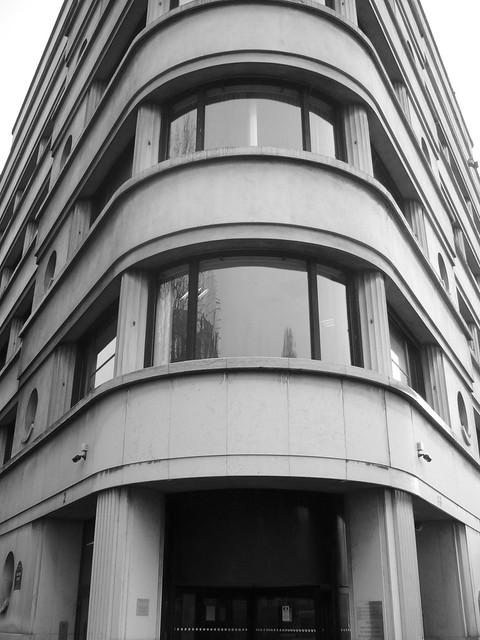
De Boulevard Diderot in Parijs komt schuin uit op de Quai de la Rapée. De T-kruising die daardoor ontstaat heeft dus een stompe en een scherpe hoek.

Een gebouw op een stompe hoek heeft vaak een gewone platte gevel met een knik erin, alsof het een rechte wand was die een beetje is gevouwen om langs de hoek te passen. Anders is het met een scherpe hoek. Daar kom je niet weg met een vouw in een vlakke wand.

Alle reden om weer eens te kijken naar de hoek van een gebouw, in het kader van onze langlopende serie. Hoe is de scherpe hoek hier opgelost, en door wie eigenlijk?
Paris

Een afgeronde hoek als deze zou je eerder in Brussel verwachten. Er zijn wat Art Déco-kenmerken, maar het zijn er zo weinig dat je eerder van post-Déco, c.q. pre-Modernisme zou kunnen spreken.

De ronde vensters, hier voorzien van koddige gebogen vensterbankjes, komen vaak voor in zulke ontwerpen, en ook de sterke horizontale accentuering past er goed bij. De verticale kozijnpartijen vertonen fraaie cannelures, en dan hebben we alle decoratieve elementen wel genoemd.

De over het hele gebouw doorlopende horizontale stroken op de borstweringen verbinden de raampartijen tot schijnbare strookvensters. Op de hoek zijn alle horizontale lijnen doorgetrokken van de ene gevel naar de andere. De grote vensters op de hoek zijn meegebogen, behalve op de begane grond, waar zich een onmiskenbare entree bevindt op twee treden boven trottoirniveau.
Paris


Vanuit de lucht - maar niet vlak voor het gebouw - te zien is dat de dakopbouw enkele meters terugwijkt, maar congruent is met de hoek in de gevel. De architect heeft er duidelijk rekening mee gehouden dat de dakopbouw van een afstand wel te zien is.

Foto: Google Maps

Het interieur is enigszins verminkt door een inrichting in Franse overheidskantorenstijl, circa jaren '80. De bewoner van het pand is dan ook de Direction générale de l'administration et de la fonction publique. Bij ons korte bezoekje tijdens een bus-overstap hebben we niet kunnen vaststellen wat deze schimmige organisatie precies doet.

Het strakke, maar enigszins gedateerde gebouw blijkt in 1933 te zijn ontworpen door André Leconte (1894-1966). Vele overheidsgebouwen en stedebouwkundige projecten van zijn hand zijn nog te vinden in Frankrijk, Libanon, Mauritanië, Syrië, Venezuela, en vele andere landen.

Bronnen:


vrijdag 30 december 2016

Season's meetings

After a ten kilometre walk through misty valleys and sunny woodsides, crossing a frosty landscape covered in rime, we sat down in a (or the) village pub in St. Geertruid for a bit of lunch.

On the pavement across the narrow two-lane road through the village a stylized huntsman in bronze was leaning his gun over a kind of shoulder-height gallows, pointing up towards some imaginary clay pigeon. About two yards to his right stood a display under a little roof, showing a map with the natural beauty spots of the region.

Wedged between the hunter and the display was a huge Christmas tree, undecorated but unmistakeably there for the season, spanning the full width of the tiled sidewalk. All the time that we were sat at the café window, not a single pedestrian attempted to use the pavement on that side of the road; they preferred to stay on our side, even hikers who popped up beside the church and had to cross the road.

When we asked the cook, who came to our table for the usual authentic chat, where she was from, it turned out that her grandfather was from E.'s home town. The cook grabbed a chair and lowered her sturdy frame, sensing the opportunity for a real conversation, rather than is everything okay for you. E. found out what the cook's surname was, and how it was spelled. With double s, and the grandfather used to be a hairdresser.

Common memories of Valkenburg, the home town, were exchanged, and experiences across the generations of leaving the province to go and live far away in the urban West were shared. The cook, Georgine, was born up there when her father had settled in the West and never spoke the Limburg dialect, while E. was raised in the South and learned the standard Dutch as a second language, not leaving the southern province until she was eighteen.

As the bus we had hoped to catch whizzed past the pub window, Georgine told us that when she was younger she had lived in The Hague, which happens to be my home town. Again memories were shared; in keeping with the winter season, it turned out that Georgine also remembered the huge fires that were lit at every road crossing on New Year's Eve in The Hague.

The morning walk on the first of January usually revealed huge craters in the road, caused by the tireless revellers, who used to tip everything they could find into the flames. Even invalid's wheelchairs would be carried to the fire. At some intersections the heat was enough to melt the copper tram overhead lines. We recalled how we used to flee the city to avoid the rowdy celebrations, only to return home on the day after to find someone's burnt-out Volkswagen parked outside our front door. Season's Greetings, The Hague style.

(Footnotes)

zondag 4 december 2016

Een gele kat in de zak

De consciëntieuze ouders van de Prinses Margrietschool hebben het waarschijnlijk niet beseft. Hun idee, vorig jaar (2015) om de Zwarte Pieten te laten plaatsmaken voor gele Minions was een creatieve oplossing, nauw aansluitend bij de belevingswereld van de kinderen op deze Utrechtse basisschool. Zonder donkere knechten zouden hier misschien geen discussies oplaaien over het Nederlandse slavernijverleden.

Een nobel en kindvriendelijk streven, maar sorry, de keuze voor uitgerekend deze gele figuren was nogal ongelukkig. De stigmatiserende knecht van Sint moet veranderen, maar de Minions helpen niet.

Waarom dan? Vanwege de betekenis. Vergelijk het met de exotische namen van sommige producten op de Nederlandse markt. Die lijken ontsproten te zijn aan een creatief brein, maar de waarheid is prozaïscher. Weinig kattenliefhebbers in Nederland beseffen bijvoorbeeld dat Whiskas hetzelfde klinkt als het Engelse woord 'whiskers', maar dan anders opgeschreven. Het betekent 'snorharen'.

Ook tekenfilmfiguren dragen soms, in onze oren, aparte en kleurrijke namen. Maar die namen zijn voor sprekers van een andere taal meteen herkenbaar als gewone woorden. Ook 'minion' is zo'n gewoon woord, en bij de gele mannetjes is het niet eens anders opgeschreven om het bijzonder te maken. Het staat gewoon in het woordenboek, en wie het woord opzoekt, snapt waarom de gele filmfiguurtjes een ongelukkige keuze waren als vervanger van Zwarte Piet: "minions" betekent "slaafse ondergeschikten". Slaafs. Ondergeschikt.

Misschien is dat de reden waarom er in december 2016 nergens meer bericht wordt over een Sinterklaas met gele helpertjes.

(Woordenboeklemma's uit ldoceonline.com en Van Dale E-N (een echt boek)) 

woensdag 20 mei 2015

Where non-Putin was not crucified: KGB building in Riga

Another instalment of our corner of a building series 

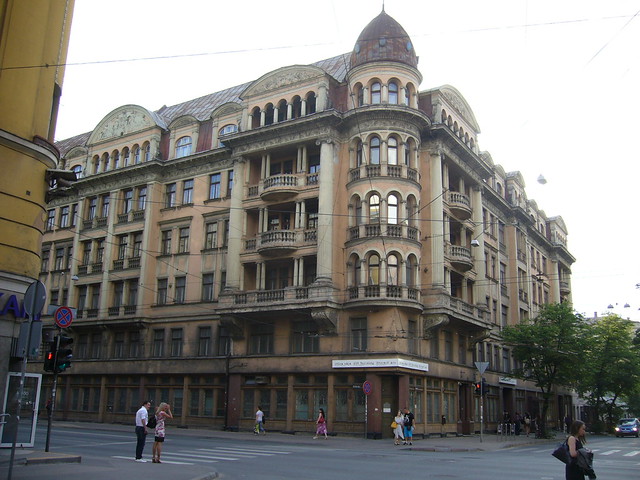
Designed by Aleksandrs Vanags, the former KGB building in Riga, Latvia sports a corner worthy of a classy city department store. In fact, the Stúra mája building was designed as an apartment building with shops on the ground floor. Its neoclassicist rigidity, however, is punctuated by details quite in tune with the Art Nouveau buildings nearby.

The left face of the corner building, for instance, features two protruding bays, each crowned by a shallow gallery and a curved tympanum. But true to the contrary, teasing spirit of Art Nouveau, these two bays are totally different. The one nearest the corner is open, with a little balcony on each floor in front of a recessed terrace. The sides of the bay are marked with two fat Doric columns.  The bay on the left, however, presents a stern, closed face with slender vertical accents. All in the Art Nouveau tradition of unpredictability.

Former KGB building in Riga


When we drop our eyes to the ground floor, though, strict repetitive classicism is back. Once a series of shop windows, the rhythmic series of narrow windows hides a gruesome past. These were the Riga headquarters of the Cheka (Chrezvychaynaya Komissiya) and its successor, the KGB, when Latvia was part of the Soviet Union.

We were inside the building in July 2014. A chilling experience, particularly on the ground floor. Upstairs, long corridors lined with small offices housed several exhibitions. What objects do you grab when you have to leave immediately? Which objects, however insignificant, have been with you at all times? Stories of unimaginable suffering, and hope, emanated from simple suitcases, well-thumbed booklets and dusty cardigans.

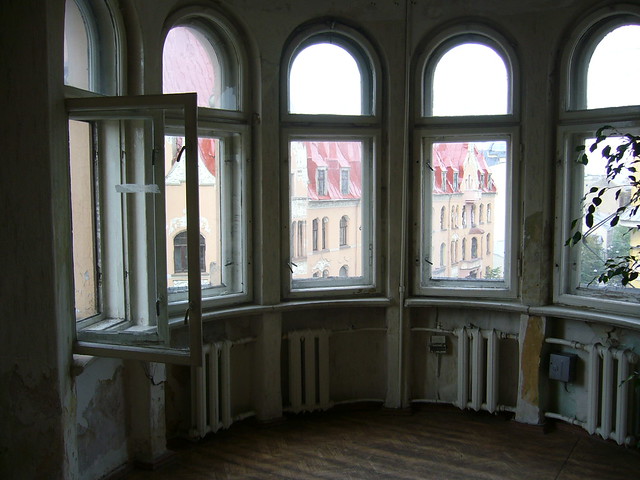
But on the ground floor, you were unexpectedly led into a dark back room where Latvian suspects were tortured by KGB interrogators. The actual room. "You came in and they grabbed you from behind. You never saw them, they were hiding behind the door." The very door through which you had just come in as a 21st-century European tourist. This building, never mind its interesting exterior, deserves to be preserved as it is, if only for the sake of its ground floor and the whiff of KGB callousness around every other corner.

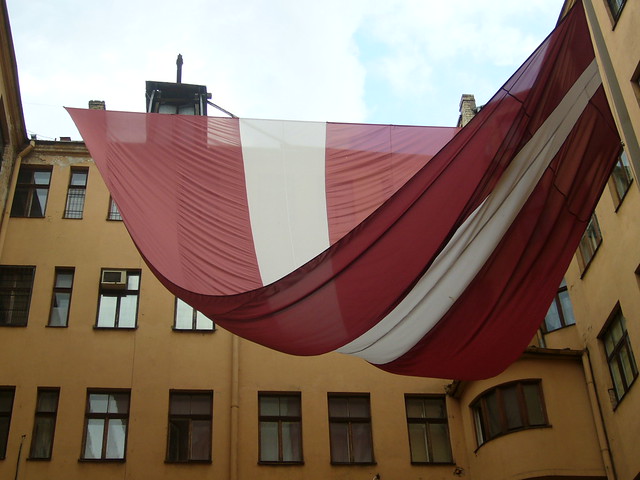
The inside court of this corner building, where an alleged Putin lookalike was crucified in 2015, may be architecturally unremarkable, but when we visited, a simple Latvian flag served as a reminder of the country's unabated striving towards permanent independence. This flag-waving was explained to us as not being the predictable nationalist move opposing the very sizable second-generation Russian minority in Latvia. They are part of the country through no fault of their own, nor of their parents. The flag simply symbolizes that Latvia belongs to nobody but those that live in the country, old and new Latvians alike.

P1080285


Returning to the original topic, corners of buildings, the corner tower of Brïvïbas iela 61 in Rïga contained round office rooms on the second to the fifth floors. No doubt they were coveted by minor officials. If only they extracted enough information from suspected Latvian civilians, maybe they would get promoted to a room like that. The thought sends shivers through one's back; even the elaborate central heating system couldn't dispel the chill of history.


Former KGB building in Riga


More about the building:
http://office.riga2014.org/wp-content/uploads/2014/10/avize_ENG_8.pdf
About the exhibitions inside the building:
http://riga2014.org/eng/news/40757-kgb-building

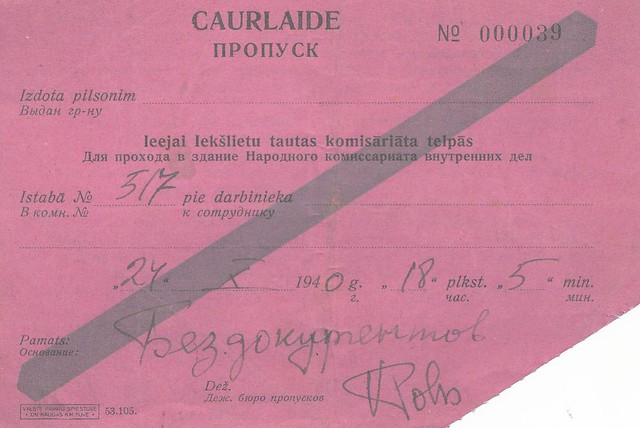
Visitors to the building, who enter through the inconspicuous corner entrance, just like summoned suspects did, are issued with an entrance pass based on the KGB one:

Riga-KGB-2014_20140729_0001

zaterdag 3 januari 2015

Curvaceous Coriovallum

Having descended the steps from the suburban station, we turned right towards the road passing underneath the embankment. Heading for a well-known interior decoration store based around mass-produced Swedish design, we followed the pavement leading us to the underpass, chatting about kitchens and cupboards. As we entered the gloom below the viaduct, we discovered a little gem.

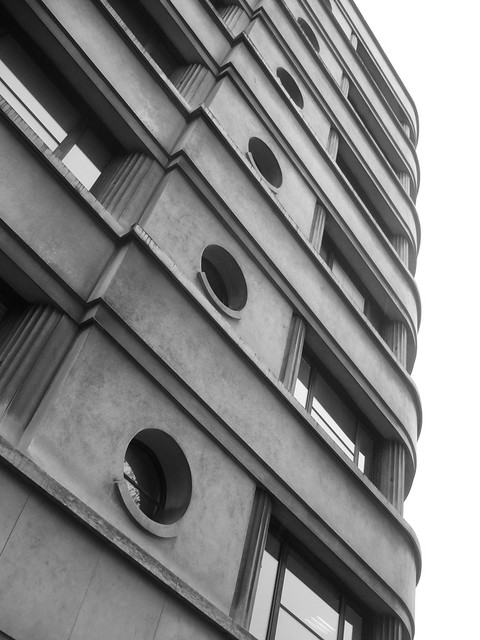
Architects are not truly dead until all of their buildings have been razed to the ground. Even by the demolition-friendly standards of the space-starved Netherlands, architect Sybold van Ravesteyn died exceedingly quickly. He passed away in  1983, and most of the edifices he designed were torn down even before that. The rest went in the following decades. Only a few traces of his highly individualistic style remain. His approach was difficult to classify; perhaps 'decorated functionalism' would fit the bill. Or 'deco modernism'.

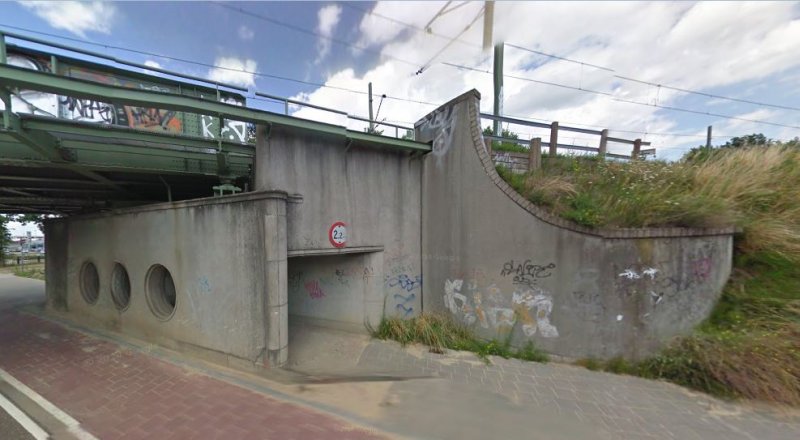
The abutments of the simple girder bridge taking the railway across the underpass on Heerlen's In de Cramer road are vintage Van Ravesteyn. The first thing that struck us were the three circular apertures, seen in many of his buildings. On closer inspection, it turned out that the abutment walls possessed quite a few decorative elements: raised surrounds on the round window edges; stone quoin patterns embossed on the narrow faces of the walls; and of course Van Ravesteyn's characteristic swinging curves. The resulting shape is totally unnecessary from a structural point of view - a straight line would have done equally well - but the bends add a pleasant looseness to an otherwise dull construction element.

Abutment. Heerlen, 23 Dec. 2014 (Photo: E.Milius)

Abutment, Heerlen, July 2009. (Google Maps)

Our companion Mr. Milius was kind enough to take a snap of the abutment, and we have added another one from Google Maps. With the image of Sybold van Ravesteyn's hidden heirloom still with us, we were sufficiently armed with curves and ornaments to face Ikea's straight lines squarely.

Footnotes

donderdag 3 juli 2014

No Milk Today


Limburg is easily the most un-urban of the Netherlands' provinces. Nowhere are you as far removed from the coast and its streetwise city life as in this southernmost appendix of the country. It's full of quaint local customs, of which the rest of the Dutch haven't got the faintest idea. Like the event which takes place every last Sunday in June in the town of Valkenburg. Or rather, outside it, in the wooded hills.

I crossed a footbridge over the Valkenburg to Heerlen railway line and climbed a wide path, sloping up quite steeply by Dutch standards, through a dense wood from which was emanating a constant concert of birdsong. No woodpeckers, I noticed.

I arrived at a somewhat muddy clearing to the right of the path - the middle of June had been quite rainy - which was full of people. To my right was a sort of improvised church altar on a stage protected by an open-sided white garden marquee. A white-robed preacher was addressing the crowd, about a hundred mostly elderly people, seated on wooden folding chairs, neatly arranged like church pews, with a central aisle. Behind their backs was the main feature of this hilltop glade: a little whitewashed chapel, surrounded by a walled garden.

Keeping to the path which skirted the clearing, I sneaked to the back of the sylvan congregation. It was a Roman Catholic service, the people mumbling in unison from time to time, responding to the preacher's formulas. But some features made it stand out from a run-of-the-mill mass: for one thing, the open-air location, making the meeting look like a clandestine church gathering or a druids' ceremony. Also, there was a women's choir, some twenty good-looking ladies with modern hairdos, dressed in contemporary black dresses, skirts, trousers even, with red accents like a shawl or an artificial flower tucked behind the ear.

On the right, on the path along which I had arrived, a lone cyclist appeared, climbing the slope, in professional racing gear, not casting the merest glance into this chapel in the glade. We might as well not have been there; conquering his natural adversary was all that mattered to him. In return, no-one on the wooden seats paid the slightest attention to him.

A tallish woman with short straw-coloured hair, seated on one of the seats in the rear was wearing a pair of oversized plastic ears, as if she had dressed up for carnival. But she looked quite sensible otherwise, her weatherproof coat buttoned up against the chill. Nobody took any notice, just like they hadn't with the cyclist.

Looking over the rows of seated believers towards the raised wooden stage with the altar, I spotted the backs of four uniformed men seated on the front row, wearing over their black tunics something looking like symbolic silver armory - shiny plates, loosely linked by chains. Any good marksman could have planted a poison arrow in the wide chinks between the armour plates, had this gear been worn in a conflict.

The preacher, a bald tubby man who must have been at least 80, vacated his central position behind the altar to make way for a lay preacher of about the same age who read a lesson.

The congregation again obligingly muttered a response at the required places. I was beginning to think that this was a regular mass after all, and my gaze wandered to the other side of the clearing, to the left of the stage. Neatly lined up with the ends of the pews was a regiment of some ten men, smartly turned out in what looked like 19th-century police uniforms. Some of them were armed with blunderbusses, others carried drums, one having a snare drum strapped to his belly. These men, and the armoured officers in the front row, I later learnt, belonged to the local archery.

As the robed preacher, who had embarked on the next part of the service, reached some significant point in the ritual, one of the archers sounded a brief drum roll. The chapel bell responded, striking twice, its clear sound reminding the people in the pews that the little chapel was still there, right behind them.

The liturgical part of the service seemed to be coming to an end. The elderly preacher and his lay sidekick exchanged a few short remarks, which made the believers chuckle. The effect of the subdued laughter rippling over the crowd was not as startling as John Cleese saying "fuck" in his valedictory speech at Graham Chapman's funeral, but it still felt odd.

After a few more pleasantries, about twelve loud shots were heard in slow but regular succession, in a salute from somewhere in the woods.

The crowd began to get up and leave, folding their chairs and handing them to an attendant who appeared from behind a tree and neatly stacked them up. But the villagers were not leaving, as I thought. They sauntered past the side of the little chapel to the other side, to another clearing. The archery lined up and marched in the same direction. One of the uniformed men held up his inverted cap, inviting contributions towards the upkeep of uniforms and instruments.

A small fairground was laid out on the wet grass on the other side of the chapel. Stalls were lining the perimeter of the open area, their backs to the forest edge. Some sold food or drinks, others knickknacks created by local artists. Long tables in the central area invited the punters to add some food and drink to the spiritual nourishment they had just received. At regular intervals, a Wheel of Fortune was spun, and the winners duly came up to collect their prizes, supplied by local businesses. A one-man orchestra was churning out popular songs, accompied by his singing-and-dancing magic synthesizer, all in two-fourth time. One of the stalls was run by the Netherlands' National Trust, the owner of the land on which the little hermitage stood. Volunteers were handing out propaganda leaflets; the woman with the plastic toy ears held a basket containing freshly picked herbs in front of visitors, challenging them to identify them.

I went back to take a closer look at the little chapel. Two guides, both retired men, explained that the building had been a hermitage: the living quarters and religious shrine of a hermit. Inside was everything you would expect to find in a full-blown church, only smaller: a bank of votive candles quietly burning, a colourful decorated ceiling, real wooden pews, an altar and a small organ.

One of the guides, a distinguished-looking gentleman called Mr Tissen told me that on one of the guided tours he regularly gave here, he had had a church choir from Aachen. "They had brought their local preacher, and it turned out he could play that thing quite well," he said, pointing to the harmonium with its two pumping pedals driving the bellows. "I went outside, and the German choir stayed inside singing the most beautiful Gregorian chants I've ever heard. It gave me goosebumps." Mr Tissen looked at me. "Isn't it fantastic?" I agreed.

A succession of devout hermits had lived here for over 250 years. All alone, living a life of religious observance and deprivation. The last one, Brother Lutgerus, left the little hermitage in 1930, disgusted at becoming a tourist attraction. The annual mass in honour of St Leonard and the fair were held to raise money for the hermit and for the upkeep of the hermitage. Though the hermitage lay deserted, the tradition was not discontinued until 1939. Thirty years and a World War later, a local group resurrected the annual event.

I left the dark, cosy chapel to have a slice of bread with scrambled egg and bacon at one of the stalls outside. No big city pizzas or shawarma here. Somehow, the snacks were in tune with the simple life that the hermits must have led here.

It was just what I needed.


(See Footnotes for additional information)


maandag 23 juni 2014

Dutch Country Diary


Here's my take on theGuardian's Country Diary.


A Country Diary

The Metaphor that Wouldn't Fly


Parus major, aka Great Tit or Koolmees
(Photo: Luc Viatour)
How sentimental. I watched two juvenile great tits leave the nest for the first time. Despite their grand name, they're pretty small birds - no more than a fistful.


I happened to glance out of the kitchen window, and saw a beak protruding from the nest box nailed to an East-facing wall in the garden. A young great tit flopped out, buzzing like a bumblebee towards the hedge opposite, which it barely managed to reach. But it did.


Following Big Sister came Little Brother. Visibly smaller, and thinly covered in white fluff below which the black and yellow was discernable, out jumped Little Brother. And flopped onto the floor below. No jump to the hedge for him.

It had been getting audibly crowded on the floor of the deep nest box. Muffled, frantic scuffling and screeching could be heard inside, the young summoning their parents to come up with the goods, which they duly did, looking increasingly dishevelled as they shuttled back and forth. The two overworked adults had clearly had enough of this.

Sitting still on the edge of a pavement slab below the next box, Little Brother did not appear to have got the hang of this flying-out thing yet. So we sit on the pavement, huh? And we try and pick little things from the gaps between them tiles? And how do I get away from here, anyway?

The little, not quite black, tit spent so long musing over its new circumstances that the sunny spot in the garden crept on, beginning to warm its little body. Little B. tried to hop, and managed to cross half the tile. And what if I rattle those wings? Goodness, that's a big jump.

Pica pica, Magpie (ekster)
Teemu Lehtinen from Salo / Helsinki, Finland CC BY 2.0
Meanwhile, I had begun casting worried glances toward a pair of magpies gleefully rubbing their wings, scurrying high up in a conifer with an excellent view of our garden. Still clutching the wet dishcloth I was wiping the sink with when this whole rigmarole began, I slunk outside, slowly lowering myself onto the garden bench. At least I was armed now.

Little Brother had made another jump and was now hanging on to a dead branch of a potted fuchsia in a corner of the terrace. One of the adults whistled a signature tune. Little Brother replied with its rough, repetitive beep beep beep, and Father Tit, or Mother, descended from the small oak tree with a mouthful of nourishment.

Big Sister was nowhere to be seen, probably gone frolicking inside the privet hedge, but Little Brother clung to his fuchsia twig in plain view, looking straight up, its beak spread wide open while its parent bent down from the only fuchsia branch in the pot that appeared to be alive. Tit Senior disgorged whatever it was - I'd rather not know - into Little Brother's beak. Little Brother appeared to derive a little more strength from this and managed another fluttering leap, ending up on the garden bench.

A new round of parental care followed, and finally Little Brother set off into the oak's leaves, where its relatives were happily tweeting and twittering, venturing out for an occasional circumnavigation of the tree. 'What? Nothing - just trying.' They stayed safely out of sight of the magpie hoodlums.

Having done the dishes I prepared to go out around the back of the house when I heard a nervous, even panicky chatter from the oak tree where a female blackbird had claimed its regular branch back.

Turdus merula, Blackbird (merel)
Andreas Eichler CC BY-SA 4.0
'Oo, she's big! Out of here!' The three black tits - parent, Little Brother and Big Sister - flew right past me as I stepped out of the kitchen door. Parent and Sister braked just in time to turn back over the hedge, but Little Brother, who looked as if he fluttered along just for fun, unaware of any potential danger, lost control and hit the kitchen window. Tock! Not a big slam, no, but not a big bird either.

Little Brother sat a little dazed on a tile below the kitchen window and scurried into the foot of the hedge when I tried to take a closer look. What a life: getting knocked out on your first big adventure.

When I came back from my errand I checked between the leaves where the tiny tit had been. Gone.

That's OK then. No stray feathers or bones left over from a magpie's feast.

Fledgling, I thought. That's what he was, a fledgling. I had used the word a thousand times in its metaphorical sense. Only now did this useful metaphor lose its status as an abstract expression. From now on I would always picture Little Brother when talking about a fledgling democracy, a fledgling enterprise or a fledgling state. Tock!


_______


Notes, 23 June 2014:

A Dutch Country Diary was written in Hilversum, the Netherlands. The only couleur locale is to be found in the typically Dutch error of the female blackbird claiming "its" branch. Yes, her branch - I know.


maandag 16 juni 2014

Been Theroux, done that

This morning as I sat on a train, re-reading Paul Theroux' The Kingdom by the Sea, about his journey around the UK coastline, a few pages fell out of my battered Penguin edition of this 1983 book.
Here they are:


Another Kingdom by the Sea

Rolling into Roosendaal station, the first stop on Dutch territory, our international train was carefully guided around a scruffy maroon two-car set waiting to set off on its shuttle service to Belgium. As if to make a point, our intercity was brought to a halt at the northernmost end of the platform, removing the slightest temptation to even consider returning south, to Antwerp.

At the guard's whistle a few minutes later, the seven carriages made a final statement to underscore that we had moved into a different country: the train shifted to the rightmost track on the line - in Belgium the train had been running on the left.

So what else is visibly different here in the Netherlands, I wondered. Until 1830, there was no border here: the Netherlands stretched further south, all the way to France, and the Northern and Southern Netherlands - hence the plural that persists in the official name to this very day - were one country. Maybe better try to spot similarities here.

Looking out of the train window at the Sugar Union factory, I thought that a sweet tooth is one of the things that is common on both sides of the border. Only the other day I had enjoyed a freshly-baked crêpe in a Brussels park, a simple concoction consisting of a paper-thin pancake, lavishly covered in vanillated sugar, rolled up and cut into bite-size portions. Served still warm in a card bag, the same shape you get your chips in, it was just what I needed to satisfy my rumbling stomach after the Belgian beer-tasting of the day before. Maybe the sugar had been produced at Roosendaal's Sugar Union.
After built-up Belgium, the landscape of North Brabant province appeared almost empty. (The geographic qualification in the name indicates that the region lies to the North of the real Brabant, which is in Belgium.) Straight tree-lined roads diagonally crossed our railway line - or perhaps the tracks cut across the roads at an angle; after all, the roads must have been there first.

In the villages we passed, like Oudenbosch and Zevenbergen, new-looking single-floor industrial buildings were situated in pleasant green grass borders - not cramped at all. On the horizon, though, below bulbous grey clouds, heavier industry made its mark in the shape of a concrete cooling tower, some tall chimneys and rows of pylons probably transporting the electricity generated there to other parts of the grid.

A couple of miles on, six wind turbines lined the waters of the Holland's Deep, clearly visible as our train sped across the one kliometre long bridge spanning this expanse. More and more of those slender spires with their Mercedes-star-shaped rotors were popping up in windy areas of the country - which is everywhere.
The arrival of the 21st century windmill was often greeted with hostility by local residents, who preferred the landscape as it was in the 19th. Despite public protests and drawn-out appeal procedures against these wind power farms, the government always won. The three-bladed turbines along the Holland's Deep spun slowly in the weak breeze, in a superior gesture of self-confidence, brushing aside the protests of the past.

A slight nervousness began to be felt as our train approached Rotterdam, a major hub in the rail network where many of my fellow passengers, together with a gentleman who might be called Mr Sing, and myself, were to change trains.

But first - as they always say on radio programmes after they've read out the preview of the show - but first, Dordrecht. A city on a river, dominated by the fat tower of Our Lady's Church, also known simply as the Big Church, completed in the 15th century.

With ships navigating the Dordtse Kil, the city of Dordt as its inhabitants call it, is an echo of the city that Rotterdam once was. Steadfastly trading, transferring cargoes, selling goods, meanwhile earning vast sums of money which were proudly ploughed back into the city. Merchants built their richly decorated homes along streets whose names derived from the trade: Wine Street, to name but one. They were displaying their wealth, but also contributing to the building of the churches and the expansion of the city, out of a sense of what I can only call 17th-century civic pride.

Dordrecht still looks like that, respectably frozen in its former glory; it was eclipsed by its young upstart neighbour Rotterdam in the 18th century, which is growing and developing still, but now looks nothing like it used to, way back then. But that's another story.


Even the view from the train on the bridge crossing Rotterdam's Meuse river has gone. We pass through a tunnel instead and arrive at the city's new central station. Mr Sing - I am adopting Paul Theroux' penchant for inventing names for people he meets on his travels - having got up too early twice before to change trains, now finally descends from the train to catch his fast connection to Amsterdam. The young, businesslike Mr Sing had asked me, on platform 5 back in Brussels whether 'this' was the train to Rotterdam. After two commuter trains had passed, it was, and we could both board the brightly-liveried carriages taking us North. Having crossed over to the fast train waiting for us, we took separate seats on the short haul from Rotterdam towards Amsterdam. When I left the train at Schiphol Airport, I reached over to shake his hand, and wished him a pleasant stay in the Dutch capital.


See Footnotes for some additional info.

maandag 17 maart 2014

Een rechthoek met drie hoeken

Zo'n knus boerenschuurtje in expressieve baksteenstijl... staat dat midden in een stad? Of ergens in de provincie Groningen, waar ook veel van dit soort juweeltjes te vinden zijn? Nee, niet in een exotische plaats als Usquert of Stadskanaal: dit pandje staat in Den Haag.

En wel midden in de stad, op de hoek van de Herengracht en de Prinsessegracht. Als je uit het Centraal Station komt, zie je het bouwsel links voor je. We bekijken een ronde hoek deze keer, in de serie hoeken van gebouwen

Huisje met een dak. Maar er is meer. Foto RK
Op foto's van Google Streetview is dit optrekje ook te vinden, maar dan geheel dichtgeplakt met posters voor concerten en dergelijke. Toen wij er waren op 7 juli 2013 zag het er gelukkig keurig uit. Gezien het hermetische uiterlijk - geen ramen - is het vrijwel zeker een utiliteitsgebouwtje. De gepantserde deur en het stalen luik ernaast zijn niet erg uitnodigend. Gevaarlijk ogende waarschuwingssymbolen op de deur wijzen op iets elektrisch, een transformatorhuisje bijvoorbeeld.

Het huisnummer is 20, in een fraai jaren-30-lettertype. Maar welke straatnaam daarbij hoort, is een raadsel: Koekamp 20, Herengracht 20, Bezuidenhoutseweg 20, Koningskade 20 - het zou allemaal kunnen, maar voorzover die adressen bestaan, zijn het stuk voor stuk andere panden.


Het dak is bedekt met groen uitgeslagen koperplaten, die gelukkig nog niet de aandacht hebben getrokken van malafide stadsjutters. Zo'n dak is dan ook moeilijker mee te nemen dan een Denker van Rodin, denk ik. Die platen zijn eropgelegd door een dekker van klasse. Kijk maar eens naar de kleine ventilatiekapelletjes, twee op de lange zijde en een op de korte. Geen soldeernaad te zien!

Wel bleek het moeilijk het loodbeslag op de gootrand plat te houden. Zie de schaduwen die de boven ons staande zon werpt op de zijkant van de dakgoot links.

In het oog lopend is het metselwerk rondom de deur: zware, afgeronde zijden in het zelden voorkomende stapelverband of strekkenverband. Meteen na de rondingen gaat het weer over in gangbaarder metselpatronen, zo te zien een kruisverband. De rondingen naast de deuren worden effectief benadrukt door de doorlopende verticale voegen die er ontstaan in het stapelverband.
De ronde linkersponning maakt het gebouwtje ineens bijzonder: de rechthoekige plattegrond krijgt hierdoor drie rechte hoeken en één ronde. Spanning door een sponning.

Ook het dak lijkt niet regelmatig van vorm te zijn: op de foto hierboven lijkt de linkervleugel van het dak steiler en kleiner dan de rechter, die we niet goed kunnen zien. Klopt dat? De luchtfoto uit het Haags Gemeentearchief geeft uitsluitsel. En ja, van de andere kant gezien:


Het gebouwtje houdt zich klein, probeert niet op te vallen, en trekt geen aandacht. Midden in het Manhattan aan de Beek hurkt 't stilletjes aan het water. Draai u om, u bent er zojuist langs gelopen!


Foto: Haags Gemeentearchief, Willem Vermeij
http://www.haagsebeeldbank.nl/afbeelding/c2d5997c-0f


vrijdag 28 februari 2014

Inbreien op z'n Portugees

Stadsplanners gebruiken het afschuwelijke woord 'inbreiding' om nieuwbouw aan te duiden op lege plekjes in de binnenstad. Uitbreiding naar binnen.

Een gevalletje van dat inbreien is dit hoekpand in Lissabon. Wandelend door de Travessa Fiéis de Deus in de Portugese hoofdstad kwamen we deze hoek tegen. Een gele stapel balkonnetjes dus, in deze aflevering van onze serie over hoeken van gebouwen. Het pand staat op de hoek met de Rua da Rosa.

De Travessa Fiéis de Deus is een smal, tot voor kort wat smoezelig, straatje, maar er is een duidelijke gentrificatie aan de gang. Weer zo'n fijn urbanistenwoord. Hier en daar zagen we een woldesignwinkeltje of een kleine fotogalerie, tussen andere pandjes die overduidelijk viswinkel of bakkerij waren geweest.

We keken dus niet vreemd op van dit fris en nieuw ogende appartementengebouw. Scherp gesneden balkonnetjes van een kwartcirkel die leken te zijn aangeplakt tegen de inspringende hoek van het pand, die zelf ook kwartrond is.  Met beton kun je tegenwoordig alles maken. Maarreh... is dit wel zo nieuw?

Met zijn vier verdiepingen heeft het gebouw ongeveer dezelfde hoogte als de belendende percelen. Daar kun je niks uit afleiden: ofwel het nieuwe ontwerp is door de architect respectvol aangepast aan de aangrenzende oudere huizen, ofwel hij moest dat doen van de gemeentelijke schoonheidscommissie, ofwel ten tijde van de bouw was het normaal om de hoogte van de andere gevels als richtlijn te nemen. Is er iets anders dat een clou geeft?


Je blik is meteen gevangen door die strakke balkons op de hoek. Als je afdwaalt naar de ramen in de straatgevels, en eens naar de detaillering kijkt, dan begin je te twijfelen. De afronding van het muurgedeelte naast de sponningen lijkt niet te passen bij de functioneel ogende, onversierde balkons. Ook de sierlijke afschuining aan het houtwerk van het venster suggereert een bouwjaar uit een  eerdere periode.


Dezelfde afronding is, bij nader inzien, ook te onderscheiden aan weerszijden van de balkondeuren. En ook daar is het houtwerk versierd met fijne cannelures.

Kortom: dit hoekpand heeft modern belijnde balkons, en is netjes geel gestuct, maar ik vermoed dat het geen 21ste-eeuwse 'inbreiding' is.  Ik hou het op de jaren 30 of 40 van de 20ste eeuw, goed onderhouden, ruim van opzet en daardoor nog altijd bij de tijd. Hoe het ook zij, het bouwwerk valt wel op, maar valt niet uit de toon.

dinsdag 14 januari 2014

Een streepje Finse zon

Filmproducers kiezen Helsinki vaak als decor voor scènes die zich afspelen in een onbestemd Oostblokland. Vaak zie je dan de witte Kathedraal van Helsinki, classicistisch met een hoog oprijzende koepel in het midden. Of de pittoreske eilandjes ten zuiden van de haven; als je de stad buiten beeld laat, kan het water makkelijk doorgaan voor een gigantisch Russisch meer, waar een enkele eilandbewoner probeert te overleven.

Maar voor onze serie Hoeken van gebouwen hebben we daar weinig aan. Finland is ook het land van strak design, en dat is goed te zien aan de foto van deze keer. Het voormalige hoofdpostkantoor (Postitalo) in de Finse hoofdstad heeft een hoek die ongeremd modernistisch is. Negentig graden, om te beginnen. Maar er valt meer over te vertellen. Bijvoorbeeld: Uit welk jaar dateert dit gebouw?
Postitalo, hoek Mannerheiminaukio/Postikatu, Helsinki. (Foto RK, 8 aug. 2013)
Het Finse hoofdpostkantoor werd (al) in 1938 gebouwd, naar een ontwerp van Jorma Järvi, Erik Lindroos en Kaarlo Borg.

Eigenlijk heeft dit gebouw een niet-hoek... het is een inspringende hoek, gevormd door de smalle zijgevels van de twee blokken die we zien. Het zijn trouwens twee zijden van een carré, maar de andere twee kanten zijn minder krachtig. Aan de voet van de hoek is de entree, nog steeds getooid met het opschrift Posti, hoewel er inmiddels andere gebruikers zijn ingetrokken: oa. de openbare bibliotheek, een eersteklas-fotozaak, en een restaurant. Bij de renovatie (door Vahanen in 2010) is het interieur netjes in stand gehouden.

Spel van licht en donker
De ingang ligt iets boven straatniveau, bereikbaar via een statige trap. De zes vertikale stroken die de gevel decoreren, lopen deels door aan weerszijden van de toegangsdeur. Mooi effect van de architect: naarmate de zon verder schuift, ontstaat er een fraai lijnenspel van licht en schaduw op de zes stroken. Op de meest rechtse strook is al te zien hoe dat lichteffect begint.

De ingang had evengoed aan het rechteruiteinde van het hoge blok kunnen liggen, dichter bij het centrum en het station, maar dan had hij een groot deel van de dag in de schaduw gelegen. En het is toch al niet erg licht op de begane grond in de Finse winter. Afgezien van deze zijgevel toont het oude postkantoor verder weinig decoratie. De natuurstenen plint en de dito sponningen, dan heb je het wel gehad.

Functionalisme
"Posti" wordt wel gerekend tot het Finse Functionalisme. Zie ook bijvoorbeeld het verpleegkunde-gebouw van de Metropolia-universiteit in dezelfde stad. Met een hoek die niet op de hoek ligt... maar dat is een ander verhaal.
Nursing department of the Helsinki Polytechnic represents functionalism
(Foto Pöllö/Wikimedia)

zondag 15 december 2013

A radio man

Ooit... was ik een radioman. Begin 21ste eeuw was er een, let op, "podcast" onder de naam Augias Radio. Iedere week vijf minuutjes nieuwe geluiden, meer niet. Het bereikte de luisteraars via een eenvoudige download, aangereikt via een RSS-feed met ingebakken audiobijlage.

De podcast. Is dat nou ook alweer nostalgie?

Waar zijn zij gebleven, Bernhard Flach, de Sloeries, de Zoldercast, de Theepod? Op podstart.nl is de laatste podcast gedateerd op 5 mei 2008. En daarna?

Maar er is hoop. Roddels zijn de beste publiciteit. Doet er niet toe wat ze zeggen, als ze maar over mij praten, dat idee. Vrij recent is http://podroddels.wordpress.com/, al zwijgt het daar ook alweer sinds 10 maart. Eh... 2012, dus.

Een artikel in VN van 2010 voorspelt de wederopstanding van de Nederlandse podcast. Zullen we dan maar?


maandag 25 maart 2013

Hoe het zit in Haarlem

Een hoek van een heel klein pandje, deze keer. In deze aflevering kijk ik naar een nagenoeg vierkant gebouwtje waarvan één hoek is afgesneden, wat een schuine zijde oplevert die niet eens breed genoeg is voor een deur. Dit bescheiden bouwsel maakt deel uit van een grandioos monument: het station van Haarlem. Ons hoekpandje bevindt zich op het eerste perron, op de hoek waar het brede deel van het perron eindigt. Het markeert zodoende de hoek van het Stationsplein en het viaduct in de Jansstraat. 

(Klik: eerdere afleveringen van deze serie Hoeken van gebouwen.)

Het station, dat uit 1905-08 dateert, is ontworpen door ir. D.A.N. Margadant, de architect van de Hollandsche IJzeren Spoorwegmaatschappij, en zijn assistent ir. H.W.M. Werker. Ons mini-hoekpandje, however, werd pas in 1912 toegevoegd aan het stationscomplex, lees ik op stationsinfo.nl.

Het bezit stijlkenmerken die je ook aantreft in het bakstenen ingangsgebouw van dit Art Nouveau-station. Zoals de consoles onder de dakgoten, de gemetselde siertorentjes op de hoekpunten en de versieringen in het houtwerk. Maar de uitvoering en het materiaalgebruik zijn wel een stuk eenvoudiger dan bij het grote gebouw. Het is opgetrokken uit eenvoudige bakstenen, en niet uit de mooiere verblendstenen van Margadants gebouwen aan het Stationsplein.
Denkend in Haarlem... (Foto RK 2006)
Wat de functie van het gebouwtje was, is aan de buitenkant niet onmiddelijk af te lezen. In vroeger tijden liepen er stationschefs, lampenisten, rangeerders, kruiers, en andere personeelsleden op het perron. Was dit misschien een kantoortje voor deze werkers of hun chefs? Nee, het had een functie voor het publiek. In de natuurstenen speklaag onder de vensters is de inscriptie "Retirade" te lezen. En nu ons dat is opgevallen, kunnen we ook nog teksten onderscheiden boven de deuren: links staat Dames, en rechts Heren.

De naam De Denker waarmee de retirade nu getooid is, komt hiermee in een heel ander daglicht te staan. Je ziet meteen De Denker van Rodin voor je, het beeld van de man die voorover gebogen zit te peinzen, zijn hoofd ondersteunend met zijn rechterhand onder zijn kin. Maar waar zat hij eigenlijk op?