De Maastrichtse gemeenteraad blijft verdeeld over de aanleg van een tramlijn naar de Belgische grens. Op dinsdagavond 6 februari 2018 werd het bestemmingsplan voor de lijn besproken, en er bleek weinig overeenstemming.
Vijf insprekers gaven hun visie, onder wie een financieel deskundig Belgisch ambtenaar die benadrukte dat de financiering van het Belgische deel, naar Hasselt, volstrekt niet zeker was. "Aan Vlaamse zijde is het kaduuk." En daar gaat het om honderden miljoenen, tegenover de circa 70 miljoen die Maastricht in de aanleg van het Nederlandse stukje moet steken. De Belgen hebben de financiering opgezet als een privaat-publiek project, maar tot nu toe is er geen private onderneming gevonden die het risico durft te dragen.
Belgisch Limburg lijkt momenteel eerder in te zetten op spoor- dan tramverbindingen over de landsgrenzen, zoals Neerpelt-Eindhoven en Hamont-Weert. Maar wethouder Gert-Jan Krabbendam heeft de garantie van de Belgische mobiliteitsminister Ben Weyts dat het geld voor Hasselt-Maastricht er hoe dan ook zal komen. Afspraak is afspraak, ofwel "pacta sunt servanda", zo citeerde Krabbendam de minister.
Hoewel het gebruik van de nog bestaande spoorbrug over de Maas al niet meer in het bestemmingsplan staat, kwam één inspreker toch met een plan om de tramverbinding via die brug te gaan exploiteren als tram-trein, met soortgelijk materieel als op de Heuvellandlijn van Arriva. De technische bezwaren tegen het samenrijden van trams en spoorwegmaterieel (goederentreinen) op dezelfde lijn vervallen dan. Ook zou de lijn zo kunnen eindigen op een perron van Station Maastricht. Inspreker Nollen: "Geef het bedrijfsleven de ruimte om zoiets te ontwikkelen. We hebben bij de A2-tunnel gezien dat dat tot een prima resultaat kan leiden."
De keuze voor een eindpunt op de westelijke Maasoever, in plaats van op de oostelijke waar het spoorstation ligt, blijft de gemoederen ook bezighouden. Voor een verlenging naar het station, inclusief vervanging van de nog niet afgeschreven Wilhelminabrug, is zo'n honderd miljoen nodig, en dat geld is er nu niet. Een deel van de raad wil zo'n verlenging niet uitsluiten, ook al is dat nog verre toekomstmuziek.
Tegenstanders onder de raadsfracties beschouwen het tramproject als kapitaalvernietiging door de overheid: als Belgisch Limburg afziet van de bouw, ligt er wel 70 miljoen Maastrichts geld in de grond. Alsof de Limburgse hoofdstad geen andere problemen heeft waar het geld aan besteed kan worden, zo stelden verscheidene fracties.
Dat niet duidelijk is hoeveel exploitatie en onderhoud van het Nederlandse deel van de tramlijn gaan kosten, is geen probleem, volgens wethouder Krabbendam: dat kost de gemeente Maastricht helemaal niets, bezwoer hij bij herhaling. "Alles komt voor rekening van De Lijn", zei hij.
Wordt vervolgd - in de voltallige raadsvergadering op 27 februari 2018. Een voorstel om de kwestie over de gemeenteraadsverkiezingen heen te tillen leek in een eerste peiling weinig kans te maken. Voor de voorstanders is het bestemmingsplan van de tramlijn een hamerstuk; de fracties die tegen zijn, geven zich niet zomaar gewonnen en zeggen in de raadsvergadering opnieuw hun argumenten tegen het tramproject naar voren te zullen brengen.
(Verslag vanaf de publieke tribune: Rob Kievit, Maastricht)
Posts tonen met het label trein. Alle posts tonen
Posts tonen met het label trein. Alle posts tonen
dinsdag 6 februari 2018

zaterdag 3 januari 2015
Curvaceous Coriovallum
Having descended the steps from the suburban station, we turned right
towards the road passing underneath the embankment. Heading for a
well-known interior decoration store based around mass-produced Swedish
design, we followed the pavement leading us to the underpass, chatting
about kitchens and cupboards. As we entered the gloom below the
viaduct, we discovered a little gem.
Architects are not truly dead until all of their buildings have been razed to the ground. Even by the demolition-friendly standards of the space-starved Netherlands, architect Sybold van Ravesteyn died exceedingly quickly. He passed away in 1983, and most of the edifices he designed were torn down even before that. The rest went in the following decades. Only a few traces of his highly individualistic style remain. His approach was difficult to classify; perhaps 'decorated functionalism' would fit the bill. Or 'deco modernism'.
The abutments of the simple girder bridge taking the railway across the underpass on Heerlen's In de Cramer road are vintage Van Ravesteyn. The first thing that struck us were the three circular apertures, seen in many of his buildings. On closer inspection, it turned out that the abutment walls possessed quite a few decorative elements: raised surrounds on the round window edges; stone quoin patterns embossed on the narrow faces of the walls; and of course Van Ravesteyn's characteristic swinging curves. The resulting shape is totally unnecessary from a structural point of view - a straight line would have done equally well - but the bends add a pleasant looseness to an otherwise dull construction element.
Our companion Mr. Milius was kind enough to take a snap of the abutment, and we have added another one from Google Maps. With the image of Sybold van Ravesteyn's hidden heirloom still with us, we were sufficiently armed with curves and ornaments to face Ikea's straight lines squarely.
Footnotes
Architects are not truly dead until all of their buildings have been razed to the ground. Even by the demolition-friendly standards of the space-starved Netherlands, architect Sybold van Ravesteyn died exceedingly quickly. He passed away in 1983, and most of the edifices he designed were torn down even before that. The rest went in the following decades. Only a few traces of his highly individualistic style remain. His approach was difficult to classify; perhaps 'decorated functionalism' would fit the bill. Or 'deco modernism'.
The abutments of the simple girder bridge taking the railway across the underpass on Heerlen's In de Cramer road are vintage Van Ravesteyn. The first thing that struck us were the three circular apertures, seen in many of his buildings. On closer inspection, it turned out that the abutment walls possessed quite a few decorative elements: raised surrounds on the round window edges; stone quoin patterns embossed on the narrow faces of the walls; and of course Van Ravesteyn's characteristic swinging curves. The resulting shape is totally unnecessary from a structural point of view - a straight line would have done equally well - but the bends add a pleasant looseness to an otherwise dull construction element.
 |
| Abutment. Heerlen, 23 Dec. 2014 (Photo: E.Milius) |
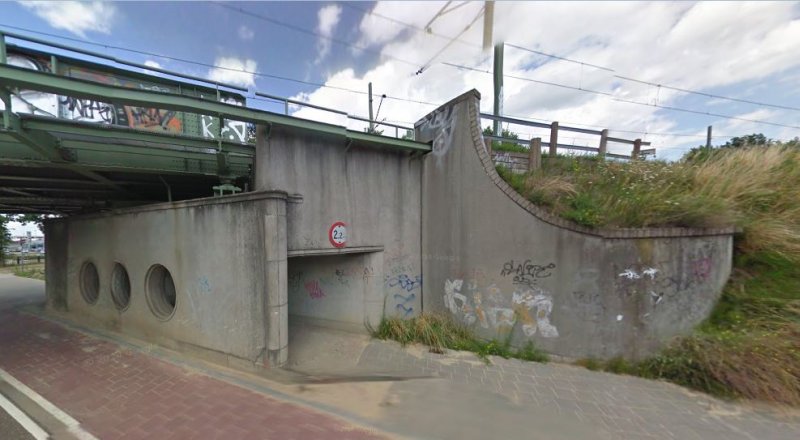 |
| Abutment, Heerlen, July 2009. (Google Maps) |
Our companion Mr. Milius was kind enough to take a snap of the abutment, and we have added another one from Google Maps. With the image of Sybold van Ravesteyn's hidden heirloom still with us, we were sufficiently armed with curves and ornaments to face Ikea's straight lines squarely.
Footnotes
maandag 16 juni 2014
Been Theroux, done that
This morning as I sat on a train, re-reading Paul Theroux' The Kingdom by the Sea, about his journey around the UK coastline, a few pages fell out of my battered Penguin edition of this 1983 book.
Here they are:
See Footnotes for some additional info.
Here they are:
Another
Kingdom by the Sea
Rolling
into Roosendaal station, the first stop on Dutch territory, our
international train was carefully guided around a scruffy maroon
two-car set waiting to set off on its shuttle service to Belgium. As
if to make a point, our intercity was brought to a halt at the
northernmost end of the platform, removing the slightest temptation
to even consider returning south, to Antwerp.
At
the guard's whistle a few minutes later, the seven carriages made a
final statement to underscore that we had moved into a different
country: the train shifted to the rightmost track on the line - in
Belgium the train had been running on the left.
So
what else is visibly different here in the Netherlands, I wondered.
Until 1830, there was no border here: the Netherlands stretched
further south, all the way to France, and the Northern and Southern
Netherlands - hence the plural that persists in the official name to
this very day - were one country. Maybe better try to spot
similarities here.
Looking
out of the train window at the Sugar Union factory, I thought that a
sweet tooth is one of the things that is common on both sides of the
border. Only the other day I had enjoyed a freshly-baked crêpe in a
Brussels park, a simple concoction consisting of a paper-thin
pancake, lavishly covered in vanillated sugar, rolled up and cut into
bite-size portions. Served still warm in a card bag, the same shape
you get your chips in, it was just what I needed to satisfy my
rumbling stomach after the Belgian beer-tasting of the day before.
Maybe the sugar had been produced at Roosendaal's Sugar Union.
After
built-up Belgium, the landscape of North Brabant province appeared
almost empty. (The geographic qualification in the name indicates
that the region lies to the North of the real Brabant, which is in
Belgium.) Straight tree-lined roads diagonally crossed our railway
line - or perhaps the tracks cut across the roads at an angle; after
all, the roads must have been there first.
In
the villages we passed, like Oudenbosch and Zevenbergen, new-looking
single-floor industrial buildings were situated in pleasant green
grass borders - not cramped at all. On the horizon, though, below
bulbous grey clouds, heavier industry made its mark in the shape of a
concrete cooling tower, some tall chimneys and rows of pylons
probably transporting the electricity generated there to other parts
of the grid.
A
couple of miles on, six wind turbines lined the waters of the
Holland's Deep, clearly visible as our train sped across the one
kliometre long bridge spanning this expanse. More and more of those
slender spires with their Mercedes-star-shaped rotors were popping up
in windy areas of the country - which is everywhere.
The
arrival of the 21st century windmill was often greeted with hostility
by local residents, who preferred the landscape as it was in the
19th. Despite public protests and drawn-out appeal procedures against
these wind power farms, the government always won. The three-bladed
turbines along the Holland's Deep spun slowly in the weak breeze, in
a superior gesture of self-confidence, brushing aside the protests of
the past.
A
slight nervousness began to be felt as our train approached
Rotterdam, a major hub in the rail network where many of my fellow
passengers, together with a gentleman who might be called Mr Sing, and myself, were to change trains.
But
first - as they always say on radio programmes after they've read out
the preview of the show - but first, Dordrecht. A city on a river,
dominated by the fat tower of Our Lady's Church, also known simply as
the Big Church, completed in the 15th century.
With
ships navigating the Dordtse Kil, the city of Dordt as its
inhabitants call it, is an echo of the city that Rotterdam once was.
Steadfastly trading, transferring cargoes, selling goods, meanwhile
earning vast sums of money which were proudly ploughed back into the
city. Merchants built their richly decorated homes along streets
whose names derived from the trade: Wine Street, to name but one.
They were displaying their wealth, but also contributing to the
building of the churches and the expansion of the city, out of a
sense of what I can only call 17th-century civic pride.
Dordrecht
still looks like that, respectably frozen in its former glory; it was
eclipsed by its young upstart neighbour Rotterdam in the 18th
century, which is growing and developing still, but now looks nothing
like it used to, way back then. But that's another story.
Even
the view from the train on the bridge crossing Rotterdam's Meuse
river has gone. We pass through a tunnel instead and arrive at the
city's new central station. Mr Sing - I am adopting Paul Theroux'
penchant for inventing names for people he meets on his travels -
having got up too early twice before to change trains, now finally
descends from the train to catch his fast connection to Amsterdam.
The young, businesslike Mr Sing had asked me, on platform 5 back in
Brussels whether 'this' was the train to Rotterdam. After two
commuter trains had passed, it was, and we could both board the
brightly-liveried carriages taking us North. Having crossed over to
the fast train waiting for us, we took separate seats on the short
haul from Rotterdam towards Amsterdam. When I left the train at
Schiphol Airport, I reached over to shake his hand, and wished him a
pleasant stay in the Dutch capital.
See Footnotes for some additional info.
woensdag 12 december 2012
Tenenkrommende talen in de Fyra
"Dat doen we zelf wel even," moeten ze hebben gedacht bij NS toen ze de omroepberichten opnamen die worden afgespeeld in de Fyra. Met het verdwijnen van de Beneluxtrein via Den Haag werden ook de viertalige berichten afgeschaft die de conducteur 'live' in de trein voorlas. Reizigers in de nieuwe Fyra tussen Brussel en Amsterdam worden nu toegesproken door een vriendelijke, ingeblikte damesstem. Van een Nederlandse dame, en helaas is het resultaat tenenkrommend.
Je wordt welkom aan boord geheten in vier talen, en de stem wenst Duitstalige gasten op gastvrije wijze "eine angenehme Reis". Reis...uh? En van reizigers die de trein verlaten, wordt netjes afscheid genomen. Duitsers die gaan uitstappen, worden aangesproken als reizigers die "hier aus teigen". Maar midden in "aussteigen" hoort toch echt een "sj".
Maar juffrouw Fyra kan het wel, hoor, zo'n "sj" laten klinken. Hoor maar: Franstalige passagiers zijn welkom aan boord van deze trein "avec destinasjon" Amsterdam Centraal. Niet fraai, want in het Frans hoort er een superscherpe S te klinken in "destinassssion".
Antwerpen
Nog bonter maakt NS het met de plaatsnamen. Die worden automatisch ingevoegd in de opgenomen omroepboodschappen. Het volgende station is: puntje puntje. Ronduit rampzalig is, dat in alle vier de talen de Nederlandse versie van de naam wordt afgespeeld. Maar Duitsers en Fransen kunnen "Amsedam Centraal" niet plaatsen, die verstaan het pas als je "Amstèrdam" zegt.
Nog bonter maakt Fyra het bij het benoemen van de Sinjorenstad. "Prochaine arrêt: Antwerpe Centraal. Nächster Halt: Antwerpe Centraal. Next station: Antwerpe Centraal." Weinig kans dat Fransen of Engelsen dat meteen verstaan, want die hebben hun oren gespitst op "Anvèrsontral" of "Aentwurpcentrol".
Beenruimte
Gratis advies aan NS: laat die viertalige boodschappen inspreken door vier mensen die deze talen ook echt beheersen. Zonder Hollands accent, en met de juiste plaatsnamen. De kans dat de 'live' boodschappen van de conducteur in vier talen terugkeren, lijkt me miniem.
Kort samengevat: De zetels in de nieuwe Fyra-treinstellen zijn prima: geen rugklachten en genoeg beenruimte. Maar na een reisje Brussel-Amsterdam doen wel mijn oren zeer en zijn mijn tenen totaal krom.
Je wordt welkom aan boord geheten in vier talen, en de stem wenst Duitstalige gasten op gastvrije wijze "eine angenehme Reis". Reis...uh? En van reizigers die de trein verlaten, wordt netjes afscheid genomen. Duitsers die gaan uitstappen, worden aangesproken als reizigers die "hier aus teigen". Maar midden in "aussteigen" hoort toch echt een "sj".
Maar juffrouw Fyra kan het wel, hoor, zo'n "sj" laten klinken. Hoor maar: Franstalige passagiers zijn welkom aan boord van deze trein "avec destinasjon" Amsterdam Centraal. Niet fraai, want in het Frans hoort er een superscherpe S te klinken in "destinassssion".
Antwerpen
Nog bonter maakt NS het met de plaatsnamen. Die worden automatisch ingevoegd in de opgenomen omroepboodschappen. Het volgende station is: puntje puntje. Ronduit rampzalig is, dat in alle vier de talen de Nederlandse versie van de naam wordt afgespeeld. Maar Duitsers en Fransen kunnen "Amsedam Centraal" niet plaatsen, die verstaan het pas als je "Amstèrdam" zegt.
Nog bonter maakt Fyra het bij het benoemen van de Sinjorenstad. "Prochaine arrêt: Antwerpe Centraal. Nächster Halt: Antwerpe Centraal. Next station: Antwerpe Centraal." Weinig kans dat Fransen of Engelsen dat meteen verstaan, want die hebben hun oren gespitst op "Anvèrsontral" of "Aentwurpcentrol".
 |
| De Fyra V250. (Foto: Arnold de Vries) |
Beenruimte
Gratis advies aan NS: laat die viertalige boodschappen inspreken door vier mensen die deze talen ook echt beheersen. Zonder Hollands accent, en met de juiste plaatsnamen. De kans dat de 'live' boodschappen van de conducteur in vier talen terugkeren, lijkt me miniem.
Kort samengevat: De zetels in de nieuwe Fyra-treinstellen zijn prima: geen rugklachten en genoeg beenruimte. Maar na een reisje Brussel-Amsterdam doen wel mijn oren zeer en zijn mijn tenen totaal krom.
zondag 18 maart 2012
A butterfly for Brussels
The city centre is attracting too much traffic. It's every urban planner's nemesis. One way to get rid of the problem, and quite a daring one too, has been proposed for the Brussels metropolis: If you want to get rid of traffic movements in the centre, get rid of the Central Station.
It's one of the options presented in a recent exhibition at Brussels's Bozar Museum entitled BRUssels 2040. Three urban planning bureaus were invited to come up with suggestions for keeping the Brussels conurbation liveable.
The Brussels Capital Region has acknowledged that the private car does not provide a lasting solution to the increasing mobility gridlock facing the city which is the capital of Belgium and the crossroads of Europe. In fact, the regional authority is envisioning a wholly or partly carless city by 2040, and the three agencies followed suit. Recent findings suggest, moreover, that the level of microparticle dust in the Brussels air is threatening public health, which provides another argument to take a critical look at car use in the city. Urban architect Paola Vigano of Studio 012 said; "The concept of a car-free city is a way to develop a sustainable city; but also a tool to visualise the city in a totally different way, to redraw it."
Concentric
In the studies mass public transit is embraced as the only way forward, combined with improvements in the rail infrastructure around the urban sprawl which is housing some 2 million people. The proposed projects do not only aim at accommodating these transport systems but are embedded in wider-ranging views on how to turn concentric Brussels, a "monopole metropole", into a multi-centred mesh. Waterways, valleys and other landscape elements are used to structure and strengthen the urban enviroment, rather than seeing them as obstacles.
Brussels is seen as part of a huge metropolitan zone stretching from Lille in France to Rotterdam in the Netherlands. Finding solutions involves thinking "both on the scale of the Eurodelta and on the scale of Brussels proper," according to landscape architect Bas Smets of the 51N4E team. And if that raises your eyebrows, rest assured that the exhibition at Bozar does a good job of visualising the sometimes arcane philosophies of the urban visionaries.
Keep the connection
Closing the Central Station on Brussels' underground cross-city link between North and Midi (South) stations does not involve closing down the link itself, far from it. After all, it took the Bruxellois about a century to design and build the thing; it only opened in 1958. And it is indispesnable for national and international rail travel. The train tunnel under the city will stay, serving trains whose itineraries take them from somewhere outside the Belgian capital to somewhere else outside the Belgian capital. Passengers who are not travelling through but have Brussels as their destination, though, will have to get off the train at either Brussels Schaarbeek in the north, or Brussels Midi in the south, according to a proposal drawn up by bureau 51N4E.
Two loops
So those passengers are left stranded in the outskirts, having to make their way to the centre and other areas of Brussels by taxi, bus, tram or metro? How is that an improvement? No, they aren't. The good people at 51etcetera propose upgrading the hardly used old, pre-tunnel rail infrastructure around the city, plus parts of the well-maintained STIB local rail network, creating two Regional Express Railway loops, with the underground North-South connection forming the overlapping bit of both loops.
The perceived need to build a RER to complement the existing train, tram and metro system was in fact what prompted the capital's authority to commission these Brussels 2040 studies. Travellers, be they tourists, business people or commuters, having transferred to an RER train, would reach their destinations by alighting at existing but currently unused or underused stations, possibly with a final leg by tram or metro taking them radially out beyond the periphery or... into the city centre. That's a much more scattered transport load than one emanating from one Central Station and radiating in all directions.
Butterfly for Brussels
A map of such a Regional Express Rail (RER) network would resemble an outline drawing of a butterfly. As a symbol of carefree metropolitan mobility in the 21st century, it would be a respectable addition to the other icons of the Belgian capital, 17th-century civil war mascotte Little Man Pee and 1950s futuristic Atomium. Go butterfly, go!
It is tempting to speculate, but beyond the scope of this piece, about the infrastructure and rolling stock needed for this approach. When train passengers change from national high-platform services to the RER, would that be running high-platform stock too? The high/low modal transition would then take place only if the RER traveller changed to a tram or bus, or to the metro, assuming all have adopted low-floor stock by 2040. The options are many, considering that much of the rolling stock of Brussels' tram and metro is due to be renewed in the decade leading up to 2040.
Two comforting thoughts
For those advocating the tram solution, it is a a comforting thought that the Studio 012 bureau, for one, explicitly retains street-level rail transport as an integral part of their solutions for Brussels 2040.
And for those familiar with the complexities of Belgium's multi-level system of government, it is a comforting thought that we have another 28 years to go before it is 2040.
The three teams who wrote the studies:
51N4E l’AUC Bureau Bas Smets
Studio 012 Bernardo Secchi/Paola Viganò
KCAP Architects&Planners
It's one of the options presented in a recent exhibition at Brussels's Bozar Museum entitled BRUssels 2040. Three urban planning bureaus were invited to come up with suggestions for keeping the Brussels conurbation liveable.
The Brussels Capital Region has acknowledged that the private car does not provide a lasting solution to the increasing mobility gridlock facing the city which is the capital of Belgium and the crossroads of Europe. In fact, the regional authority is envisioning a wholly or partly carless city by 2040, and the three agencies followed suit. Recent findings suggest, moreover, that the level of microparticle dust in the Brussels air is threatening public health, which provides another argument to take a critical look at car use in the city. Urban architect Paola Vigano of Studio 012 said; "The concept of a car-free city is a way to develop a sustainable city; but also a tool to visualise the city in a totally different way, to redraw it."
Concentric
In the studies mass public transit is embraced as the only way forward, combined with improvements in the rail infrastructure around the urban sprawl which is housing some 2 million people. The proposed projects do not only aim at accommodating these transport systems but are embedded in wider-ranging views on how to turn concentric Brussels, a "monopole metropole", into a multi-centred mesh. Waterways, valleys and other landscape elements are used to structure and strengthen the urban enviroment, rather than seeing them as obstacles.
Brussels is seen as part of a huge metropolitan zone stretching from Lille in France to Rotterdam in the Netherlands. Finding solutions involves thinking "both on the scale of the Eurodelta and on the scale of Brussels proper," according to landscape architect Bas Smets of the 51N4E team. And if that raises your eyebrows, rest assured that the exhibition at Bozar does a good job of visualising the sometimes arcane philosophies of the urban visionaries.
Keep the connection
Closing the Central Station on Brussels' underground cross-city link between North and Midi (South) stations does not involve closing down the link itself, far from it. After all, it took the Bruxellois about a century to design and build the thing; it only opened in 1958. And it is indispesnable for national and international rail travel. The train tunnel under the city will stay, serving trains whose itineraries take them from somewhere outside the Belgian capital to somewhere else outside the Belgian capital. Passengers who are not travelling through but have Brussels as their destination, though, will have to get off the train at either Brussels Schaarbeek in the north, or Brussels Midi in the south, according to a proposal drawn up by bureau 51N4E.
Two loops
So those passengers are left stranded in the outskirts, having to make their way to the centre and other areas of Brussels by taxi, bus, tram or metro? How is that an improvement? No, they aren't. The good people at 51etcetera propose upgrading the hardly used old, pre-tunnel rail infrastructure around the city, plus parts of the well-maintained STIB local rail network, creating two Regional Express Railway loops, with the underground North-South connection forming the overlapping bit of both loops.
The perceived need to build a RER to complement the existing train, tram and metro system was in fact what prompted the capital's authority to commission these Brussels 2040 studies. Travellers, be they tourists, business people or commuters, having transferred to an RER train, would reach their destinations by alighting at existing but currently unused or underused stations, possibly with a final leg by tram or metro taking them radially out beyond the periphery or... into the city centre. That's a much more scattered transport load than one emanating from one Central Station and radiating in all directions.
Butterfly for Brussels
 |
| © 51N4E l'AUC BBS |
It is tempting to speculate, but beyond the scope of this piece, about the infrastructure and rolling stock needed for this approach. When train passengers change from national high-platform services to the RER, would that be running high-platform stock too? The high/low modal transition would then take place only if the RER traveller changed to a tram or bus, or to the metro, assuming all have adopted low-floor stock by 2040. The options are many, considering that much of the rolling stock of Brussels' tram and metro is due to be renewed in the decade leading up to 2040.
 |
| © Studio 012 |
For those advocating the tram solution, it is a a comforting thought that the Studio 012 bureau, for one, explicitly retains street-level rail transport as an integral part of their solutions for Brussels 2040.
And for those familiar with the complexities of Belgium's multi-level system of government, it is a comforting thought that we have another 28 years to go before it is 2040.
The three teams who wrote the studies:
51N4E l’AUC Bureau Bas Smets
Studio 012 Bernardo Secchi/Paola Viganò
KCAP Architects&Planners
Abonneren op:
Posts (Atom)